Blog contribution by Jamie Hammer BSN, MSN, EDAC
For many of my NIHD colleagues, the question of GO or NO GO relates more to the work we do in Transition Planning. It is a decision regarding readiness. Is the building ready? Is the staff trained? Are all our ducks in a row to open and begin treating patients?
Unless you are like me, and it is an internal debate of returning to the classroom.
You have all seen the cartoons with the angel on one shoulder and the devil on the other trying to convince the person of what he/she needs to do. Well, I had a 20-year-old version of me on the left side and a 60-year-old on the right.
The youngster said, “you always wanted to be a professional student, go for it!” Yet, the old lady kept whispering “Why? You have already had a career. You are getting old. Just have fun.”
So, I listened to the mature woman and built clay pots two inches high, sculpted battle ships out of Styrofoam, and soldered the ugliest candlestick you have ever seen. All the while, the youngster kept whispering “you have another degree in you!”. Like many, my 20s were for the BSN, 30s for the MSN, with working and raising a family thrown in the mix. I never dreamed of a Doctorate, until my storage room was filled with useless art projects!
For those of you thinking about returning for an advanced degree at a “advanced” age, here is what I learned:
1. Experience pays off.
After close to forty years of nursing, I’ve had a few experiences. Some I would never want to relive and others I thoroughly enjoyed.
But let’s start with nursing school. Unlike childbirth where those painful moments drift away when you hold your child, the BSN is one of the most rigorous degrees and the memories do not fade! The endless nights of studying, care plans, and anxiety over the early morning clinicals flash back at the mere mention of those years.
By the MSN, you have a little nursing skill under your belt. You have practiced in the field you are wanting to study and have a working knowledge, or the how, and now it is time to gain an in-depth why of the skills gained. The MSN seems a little easier even though you have more life commitments.
By the DNP, you know exactly what you want to concentrate on. That focus comes from experiencing situations that you see as needing changing, streamlining, or justification as why they are done the way we do them. The DNP, although time consuming, was by far the least difficult of the nursing degrees.
2. Look back at your favorite experiences.
Like all of us that have been a nurse for a few minutes, we have had positions we loved and ones we counted the days until we could move on.
As a career Navy Nurse, I have been a bedside nurse up through the ranks of leadership. I learned very early on that the Emergency Room or Intensive Care Units were not my niche. I was not cut out for the fast pace, the frequent bedside alarms, and the tracheostomy care! Pediatrics was off the table also as I would tear up when a child was in pain. Mid-level leadership was a challenge that I learned a lot but would not want to repeat. Education and Training was fun but became too repetitive. Behavioral Health held my interest for many years, but burnout effects even that specialty. I enjoyed upper-level leadership but found that I had very little time for myself.
What became my favorite position was Healthcare Design. I could use my leadership, bedside nursing, teaching, and behavioral health skills all in one job. I could make a tangible lasting difference for not only the patients but the staff. It was the job I didn’t want to leave. But the needs of the Navy prevailed, and I was transferred after the new hospital was built and moved into. After retiring from the military, I joined the ranks of a government contractor continuing in my favorite job.
3. Find a program that allows you to focus on those experiences.
Don’t just look at a school’s DNP programs on the internet, call or email them with your interests. Find out if they have someone on their staff that will work with you on what you are interested in. I spoke to three department chairs on how I wanted to do a project on the impact that the physical healthcare environment has on patients and staff.
All three schools were online, accredited, asynchronous, with 2-3 long weekends of immersion at that school during the program. Because of where I live, I chose a school that allowed a focus on the environment through their Leadership Tract, had similar values, and is in the same state.
If you reside in another state than the school you choose, make sure that school has an affiliation with your state. It makes it more convenient to do clinical hours and a project near your home. In my case, I work remotely in Maryland and live in Washington state. I was unable to do my project associated with my work in Maryland due to the lack of an affiliation agreement. Fortunately, my town’s local community hospital was completing a construction project that presented an opportunity to conduct a Program Evaluation on.
Finally, there are so many schools out there and so many tracts to take. Ask colleagues, friends, and others about their programs before you commit.
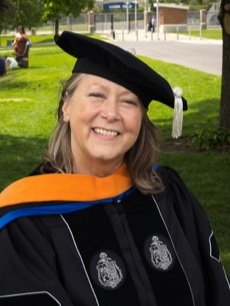
After having finished my degree, I am so glad I did it.
I now look at data and research a little differently. I question why we do things “that we have always done”.
Do I use what I learned in the DNP experience in my current position. Absolutely!
On a recent work trip, I drove by American University in DC and that youngster on my shoulder uttered, “What’s next?”