PDC 2026 Closing General Session:  Resilience by Design:  Preparing Healthcare Environments for Disruption and Disaster 

Blog contribution by Brooke Karlsen, MSN, BSN, RN, NEA-BC, EDAC


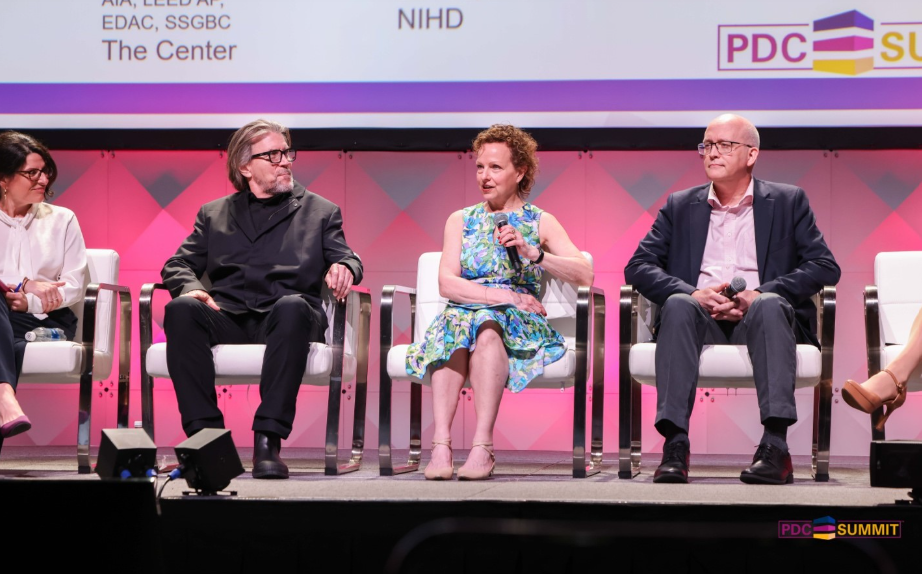
I was privileged to represent NIHD along with representatives from the other partner organizations for the PDC Summit held in Houston in March 2026. The intent of the session was to bring experts from across healthcare planning, design, engineering, and clinical communities to explore how resilient environments are created and sustained. Through real-world examples and forward-looking strategies, the panelists were charged with providing insight into how healthcare spaces can remain safe, functional and supportive during times of crisis. This is a topic that I have significant experience in over a 35+ year career in nursing and hospital operations, particularly while serving as the Incident Commander for the region in the healthcare system where I was employed as the VP of Operations during the COVID pandemic. However, as a panelist for this session, I was charged with representing NIHD, not necessarily my personal views. Some of the questions were asked of all the panelists and some were directed to particular individuals given the unique perspective of the representing organization.

The following is a synopsis of the answers I provided. 

What does resilience mean to your organization? 

Resilience can be defined in several ways; as the capacity to withstand or recover quickly from difficulties, or “toughness,” elasticity, being able to spring back into shape. NIHD is a relatively small organization, but has diverse membership in terms of where our members work.  Most, but not all are clinicians. We work for architecture, engineering and construction firms, for healthcare organizations as administrators, project managers, in facilities departments, as transition and activation planners, as independent consultants or consultants for large healthcare firms, as equipment planners, industry representatives, built environment researchers, and as university educators.

With this diversity of perspective, resilience is not going to have a universal meaning to all our members, yet NIHD values this diversity of experience, in part because we see it as foundational to resilience. 


We say ‘resilience’ a lot. In your lane what does ‘resilient environment’ concretely mean?  

From NIHD’s view and the diversity we bring, it can mean three things:

One, the power of a material or a “building” to respond to crisis or disaster and then return to its original form after being stressed. 

Secondly, it’s also the ability of a “person” to adjust or recover readily from adversity, stress or a major life event.

Thirdly it is the ability of a “system” or an “organization” to recover readily from a crisis or disruptive event such as a disaster.

Resilience is about being prepared for and having the ability to respond appropriately in order to resume normal operations and services promptly. In a disaster, you have to be able to morph and respond to what’s needed in the moment, and the next hour, the next day and the day after that. 


What’s a common misconception you bump into? 

My answer is twofold. One, the lack of understanding or recognition of resilience’s psychosocial aspect. Resilience is the process and outcome of adapting to difficult or challenging events and experiences especially through mental, emotional and behavioral flexibility. A common underappreciation is how closely resilience is tied to operational preparation, planning and the total system preparedness side within healthcare settings. 

Being prepared and staying prepared and thus being able to react effectively at the time of a disaster has everything to do with resilience! 


Describe an event from the last 2–3 years that changed how you think about resilience—what did it reveal?” 

My example came from a Transition and Activation project I was leading for an Outpatient GI Procedure Center and Clinic. We were about to open the center and had our health department facilities inspection in the morning, which included the test of the generator power switch and the full test of the fire alarm system. After passing this milestone, we were scheduled early the next day for the licensure inspection by the nursing surveyor. In the afternoon after the facility inspection, the post-procedure area experienced a sudden rise in temperature. A technician was quickly dispatched to check and repair the air handling unit on the roof of the building. Upon opening the panel, a burst of flame came from the unit (fortunately, not harming him!). By this time, it was close to the end of the day, and repair in time for the next morning’s inspection looked unlikely.

I told the construction team that we had to notify the facilities inspector to be transparent about this event and to obtain guidance and direction about reinspection of the effected components of the facility and whether we could proceed with the licensure part of the inspection the next morning. Some team members on the construction and design teams were not supportive of that call and the need for the transparency that just seemed so basic and foundational to me.

It revealed to me that public trust is foundational to resilience and transparency is key to public trust. There is a reason why nurses ranked the most trusted professionals in Gallup’ annual poll for the 24th consecutive year! 


If you could implement environmental or design changes to support patient care during high-stress or emergency situations, what would you prioritize? 

Esteemed colleagues on the stage spoke to some architectural and engineering considerations and features but I wanted to emphasize the role of standards. The ability of a hospital to respond and recover from emergencies and disaster incidents is a safety imperative and a regulatory requirement. CMS issued standards, and accrediting bodies such as the Joint Commission have evolved requirements based on best practices.

These standards leverage NFPA-defined functions of an emergency program (consisting of responsibilities, education and exercises) and provide a framework for ensuring effective operations during all phases of a disaster (mitigation, preparedness, response and recovery). 

Hospitals must be able to meet increased demand and provide uninterrupted services, be self-sustaining for up to 96 hours and prioritize critical resources, (such as staffing, space and supplies). 

Rather than focusing on specific types of disasters, standards promote a comprehensive all-hazards approach for a broad spectrum of emergencies. Hospitals utilize the Hospital Incident Command system, or “HICS” which is a standardized approach to the command, control and coordination of emergency response and integrated with the National Incident Management System.  It consists of a standard management hierarchy and procedures for managing temporary incidents of any size and is designed to be used or applied from the time an incident occurs until the requirement for management and operations no longer exists. So, for example in a previous role as a VP for Operations for a community hospital, I have served as the incident commander during a train derailment incident that lasted only a matter of hours, and then in the COVID pandemic, where I served in this role for months. 

Key to this disaster response is education and preparation at all levels, mock events, learning and improving through analyzing the response as well as making improvements based on the lessons learned from actual disaster responses. For the greater good, this topic calls us to share experiences and best practices to learn from others. 


What advice do you have for ensuring that multidisciplinary voices are meaningfully included and heard throughout the design process? 

NIHD’s entire Mission is to engage and integrate clinical expertise into the planning and design of healthcare built environments and our Vision is: “Shaping the Future of Healthcare Environments Through Clinical and Professional Leadership”. We achieve this through Leadership, Education and Advocacy. We prepare nurses and others to participate in collaborative and interdisciplinary forums to be meaningfully included at the table in the design process through all the phases of a project from inception to post occupancy operations, using modules, tools, and other educational modalities. Ensuring multidisciplinary voices are heard takes a great effort and commitment and cannot just be lip service.   

Several NIHD members, like myself serve on the FGI Health Guidelines Revision Committee providing the clinical voice and expertise to the Guidelines’ every four-year update. In healthcare design, key to planning is the FGI Safety Risk Assessment or the SRA, which targets eight areas of safety and particularly the Disaster, Emergency, Vulnerability Assessment (or the DEVA as it is abbreviated). The DEVA calls us to examine the potential Human, Natural, and Technological Disasters taking the likelihood of different kinds of events taking place and the potential consequences, to prioritize where a health entity should focus and plan for early in the project.  All too often facilities skip this process and then try to back into developing plans, post-opening, which is way too late in the process.   


I would like to recognize and thank NIHD members who answered my query or contacted me directly after I solicited responses on the NIHD Member Connect portal:  Kaycee Shiskowsky, Ashley DaCosta, Gary Schindele and David Denenno.

I appreciate your time and sharing of resources as I prepared for the panel presentation. Julie Dumser, thank you for your critique and commentary on run through.

Lastly, a shout out to Nick Gabrielle of Jensen Hughes who as always, shared generously.